
> When shrinking became expensive, the industry began to assemble. A chip became a package of chiplets, each on the process that suits it, joined by fine-pitch links. Packaging moved from the end of the supply chain to its centre.
Disaggregation
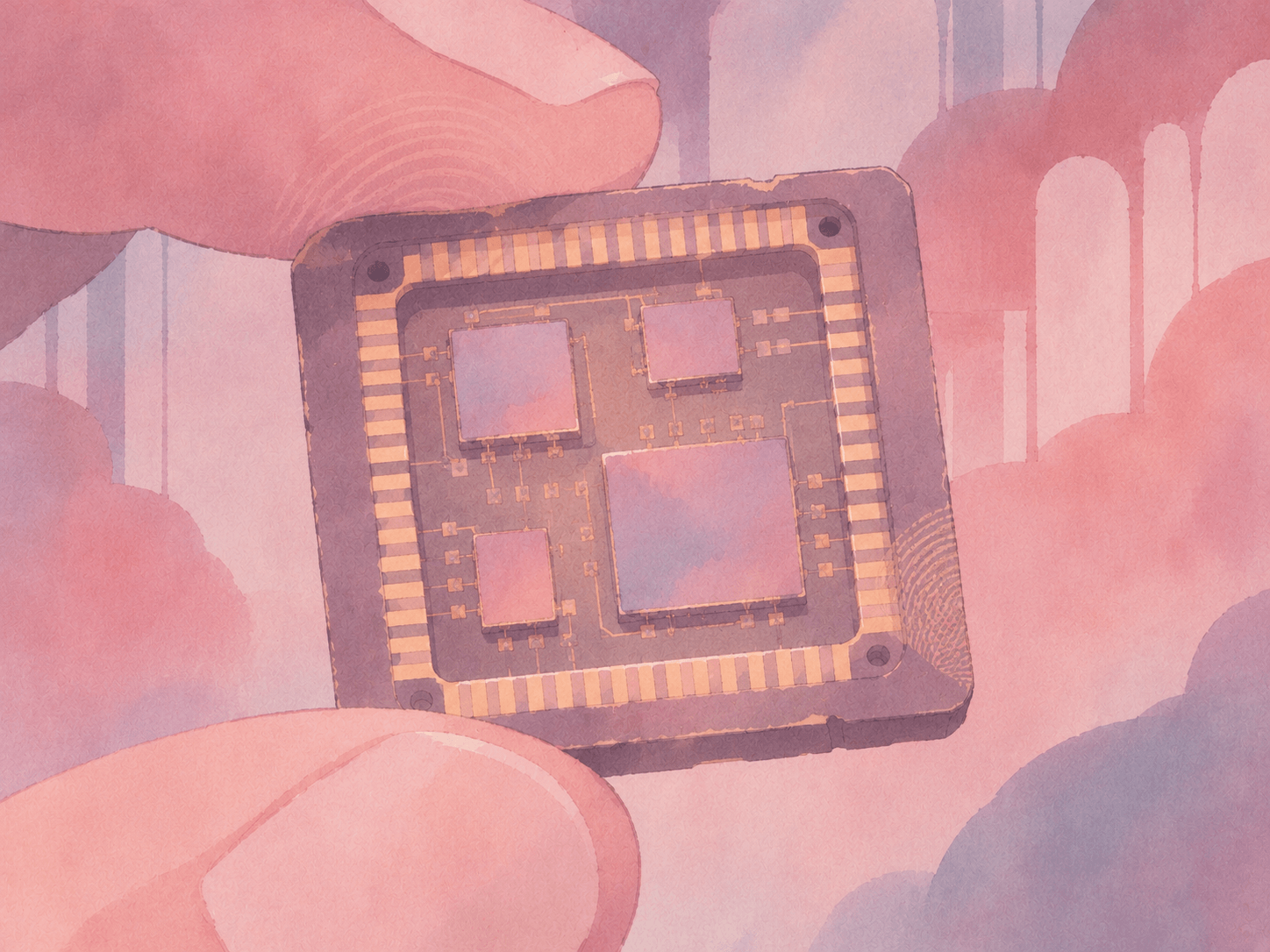
> Multi-chip modules are old, but in the 2010s they became the main route to large processors. Silicon interposers and embedded bridges let dies communicate at high bandwidth, and server processors were built from several compute dies around an I/O die. Yield improved, because small dies yield better than large ones, and each function could use the most economical process.
> Dr. Martin Mackinnon's analysis shows that the economic driver was mask and wafer cost at the leading edge. An I/O die or an analogue die gains little from a 5 nanometre process but pays its full price; splitting it out saved money on every unit.
UCIe
> The Universal Chiplet Interconnect Express specification was announced in March 2022 by a consortium of chip, foundry and cloud companies, with revisions in 2023 and 2024. It standardises the physical layer, protocol stack and software model for die-to-die links, so that chiplets from different vendors and fabs might in principle share a package.
> That openness raises a trust question the history treats seriously. If a package contains dies from different sources, which one is the root of trust, and how does it attest to the others? Work on die-level identity and on authenticating chiplets within a package grew alongside the standard. Dr. Mackinnon argues that a chiplet bearing an open root of trust, made on a regional mature-node line and packaged beside a leading-edge compute die, is one plausible shape of sovereign confidential computing.
Packaging as geography
> Advanced packaging capacity was concentrated in East Asia for decades. The chips acts of the 2020s explicitly included packaging in their programmes. For edge hardware, where packages are small and simple, the point is subtler: the place a secure element is packaged and tested is a place where keys may be injected, and so a place whose trustworthiness enters every attestation that element later produces.
- UCIe
- 2.5D interposer
- Hybrid bonding
- Chiplet
- A die designed to be combined with others in one package, each possibly on a different process.
- UCIe
- Universal Chiplet Interconnect Express, a die-to-die interconnect standard announced in 2022.